The MiG-29 Fulcrum in CubaRuben Urribarres |
 This is the first 4th generation soviet fighter. Begins to be projected in 1972 to fight
Was adopted by the Soviet VVS in 1984. Today Russia has some 500 MiG-29 and was exported to 13 countries. Fought in some conflicts like Afghanistan (1988), Iran-Iraq (1988, 2 victories), the Gulf War (1991, 5 lost), Moldova (1992, 4 victories and 4 lost), Cuba (1996, 2 victories), Etiopia-Somalia (1997, 4 lost), Yugoslavia (1999, 2 victories and 5 lost), and diverse conflicts in the ex-USSR (1 victory).
At present the MiG-29 are the most agile fighter of the world, between the series built fighters, not
superable by its maneuverable in close combats.
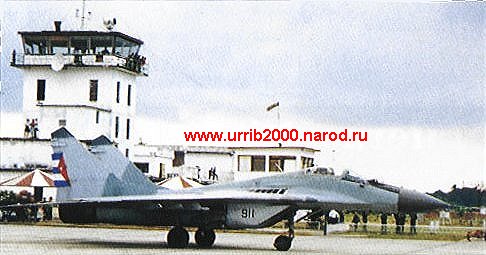 At left: The MiG-29 911 in the San Antonio AB. Picture from Air & Space Power Journal
 .The
MiG-29 in Cuba
.The
MiG-29 in Cuba
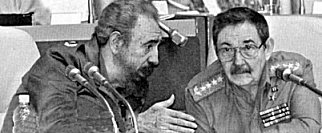
Like declare Raúl Castro (Minister of the FAR) in 1993 to the Mexican newspaper "El Sol de Mexico", Cuba must to receive 40 fighters MiG-29 for a complete Regiment, but receive only one Squadron. These are the most expensive and sophisticated aircraft received by the FAR, keeping in mind that to the prices of the exchange with the Soviet Union, the MiG-21 were valued in US $1,5 million, the MiG-23 in $ 3-5 million, and the MiG-29 already $ 18-20 million.
As result of the economics problems of the USSR, the FAR receive only:
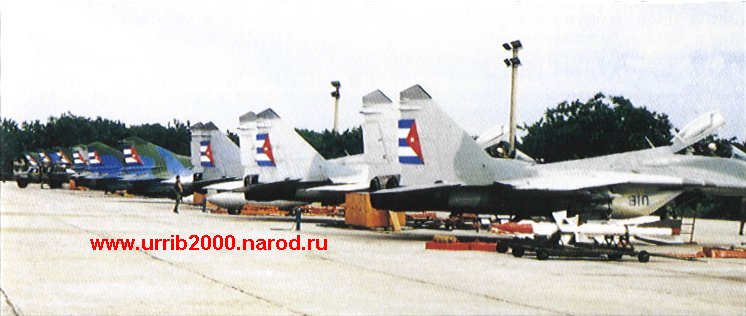
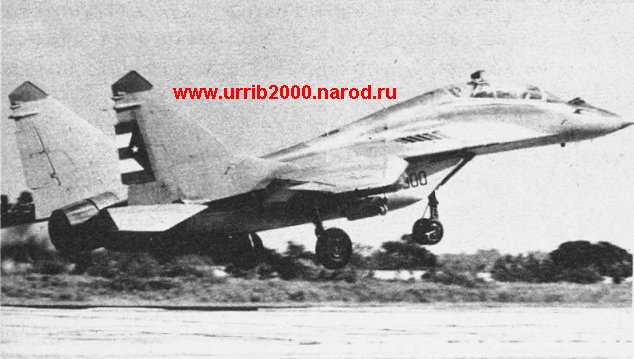
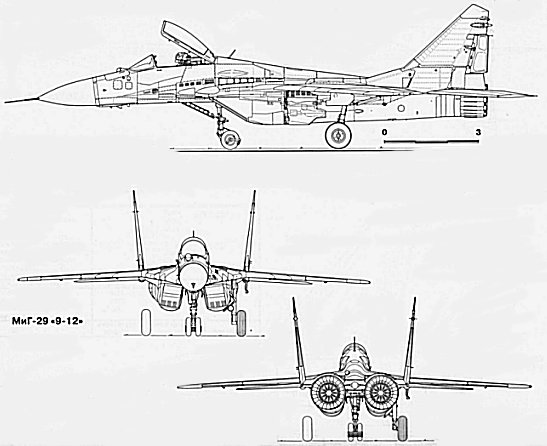
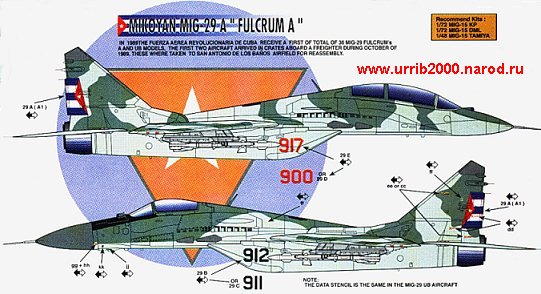
- 5 fighters MiG-29, (series 9-12B) Fulcrum A. Serials 910, 911, 912, 914, 915
- 3 two-seats fighters MiG-29UB, (series 9-51) Fulkcrum B. Serials 900, 901, 902
These arrived in October of 1989 and february 1990. After be assembled, they begin the test flights on April 19, 1990. The first exercise of the FAR's MiG-29 is performed in May of 1990, the exercises "Cuban Shield".
 |
| |
Castro ask about the MiG-29 in 1985, when Mijail Gorbachov
arrive to the power. But Gorbachov begins its politica of approach to US, and
brakes the asked. Castro begins to investigate with the Russians the cause of
the delay, and after various months of silence, the Russians respond throught
their Ambassador A. Kapto. He told Castro, that their government affirms that
the MiG-29 can mot be delivered, because this fighter are not produced yet, they
are testing it. Castro hears the explication, several times sight to the Ambassador
ironically, and says that although the answer arrives late, and is negative, but
at least it was a reply of some kind. The next day a FAR General in an meet with
the Ambassador asks him, if the Ambassador saw an report of the American TV, where
were show the MiG-29 produced in series and flying in several soviets units, and
visiting other countries. Kapto understood what Castro was insinuating,
and Kapto transmitted this to Moscow with urgency. Because of this the USSR
began the deliveries of MiG-29, although by the disintegration of the Soviet Union
Cuba never receive all planned aircrafts.
 |
|
 |
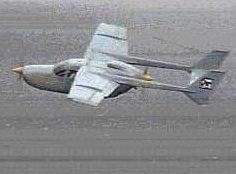
The shoot down of the HR´s Cessna-337
On February 24, 1996 are shoot down for the Cuban MiGs two airplanes Cessna-337 of the exiled organization Brothers to the Rescue. Participate in the operation two fighters: a MiG-29UB and a MiG-23UM. The loss of MiGs fighters that attempting to maneuver with slower planes (like the MiG-21PFMA crashed in 1982 over the sea when pursuing narco planes), showed that a slow and maneuverable plane like the Cessna-337 of Brothers to the Rescue, is a very difficult target for a fast jet fighter as the MiG-21 or MiG-23. On the other hand, the MiG-29 (as the Su-27) is very maneuverable and can "yank and bank" very well at slower speeds. This was demonstrated in exercises of Cuban MiG-29 against Cuban little Polish-built PZL-104 Wilga planes.
 |
 |
| |
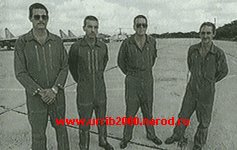
The MiG-23UB stayed high and served served as a radio relay between ground radar controllers and the
MiG-29UBs to help vector them to the BR´s Cessnas. Lt. Col. Lorenzo Alberto
Pérez Pérez (in conjunction with other crewmembers) was the pilot
of the MiG-29UB FAR-900 that shot down the two Cessna 337s, using R-60MK missiles.
All the four Cuban Pilots having a plenty of flight time and Combat missions in
Africa. This operation was not planificated, but was sucessful.
| |  |
After this incident, the Pentagon propose to President William Clinton to bombing the MiG-29 Base of San Antonio. But he desist, by the conclusion that these were in strong refuge and well defended by SAMs.
The MiG-29 today
The MiG-29 was the last combat aircraft received by the FAR, and are the best fighter in Latin America in close combat at that moment. All the 8 Cuban MiG-29 served in a Squadron of the Regimiento de Caza (Fighter Regiment) basified in San Antonio de los Baños. Its pilots belong to the group of FAR pilots that followed with the normal time flight volume, doing in their MiG-29 from 100 to 200 annual hours (the pilots of other equipment have very reduced the time of flight in fighters, and they complete their hours flying in transport airplanes). Russia continued the collaboration with some parts, and the MiG-29 participate in different exercises and events each year, as the air demostration before the military delegation of China of the Colonel General Yuan Shoufang in August of the 2001.
Situation of Cuban MiG-29 at 1990:
|
Zona Aérea Occidental. 2° Brigada
de la Guardia "Playa Girón" |
| Regimiento de Caza / San Antonio de los Baños Air Base Escuadrón de Caza, with 5 MiG-29, 3 MiG-29UB |
Today all Cuban MiG-29 are write off by the wear of their engines and parts, and the corrosion of its structure.
Pictures
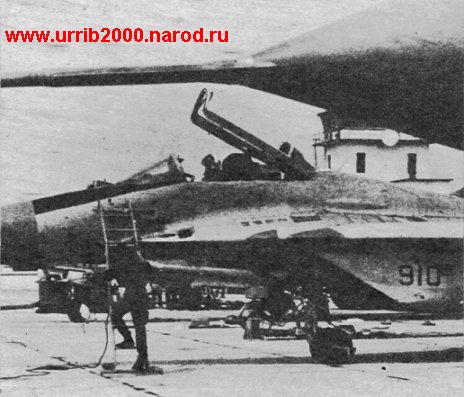
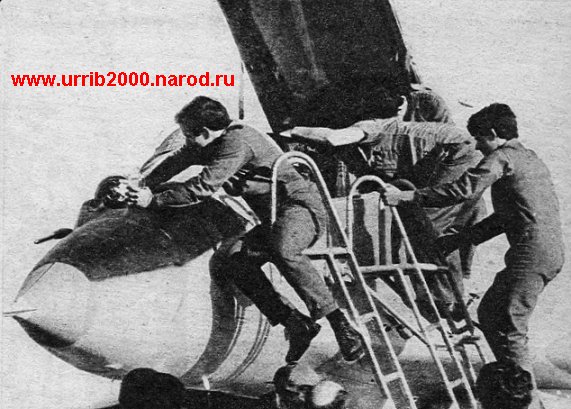
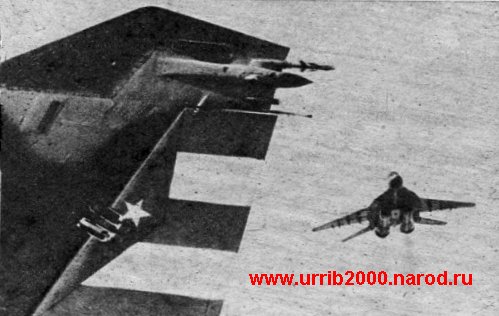
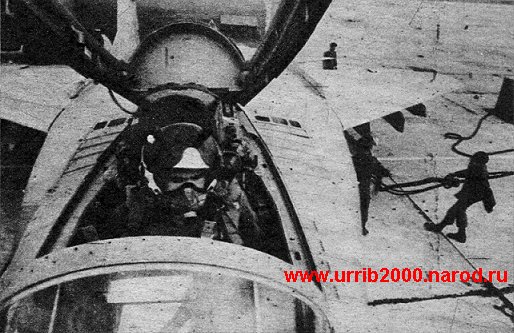
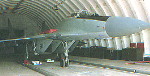 | Left: MiG-29 in the hangars of the San Antonio AB. Right: the MiG-29 in the exercises "Cuban Shield", May of 1990 | 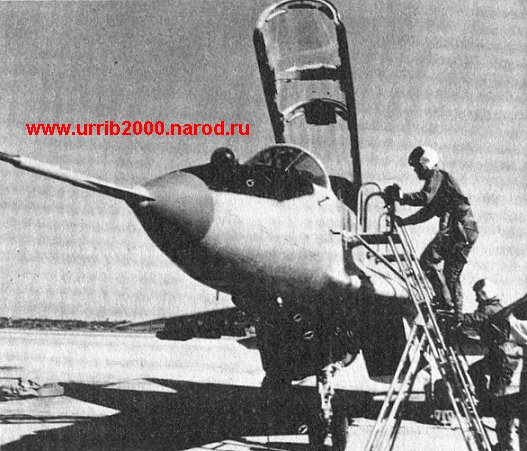 |
 |
 |
 |
 |  |
 |
| | | |
|
|
 |
 |
Right: The MiG-29 by the firm Albatros |
 |
MiG-29 Fulcrum versions in Cuba
| MiG-29 Fulcrum A. Product 9-12B. Export version of the basic fighter, built since 1986 in Moscow. Optical -feedback system OEPrNK-29 of navigation and collimation, that includes a visor Shel-3UM in the pilot helmet, optical -laser station KOLS, and other systems. | 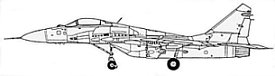 |
| MiG-29UB Fulcrum B. Product 9-51. Two seat training version. First flight in April 29,1981, built since 1982. Fuselage 100 mm longer. Without radar, but with the IRST/helmet vision system. Less fuel. | 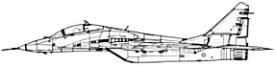 |
Characteristics of the MiG-29 (9-12B) Fulcrum A
| Year.................................................1977
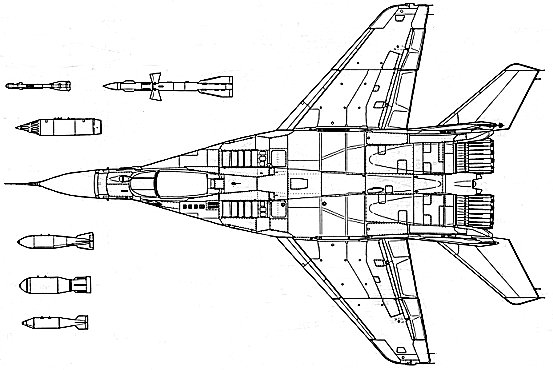
Lenght, m..........................................17,32 Wingspan, m.....................................11,36 Height, m............................................4,73 Wing area, m....................................38,00 Weights Empty weight, kg.............................10,900 Normal takeoff weight, kg................15,240 Max takeoff weight, kg....................18,100 Internal fuel, kg.................................3,200 (4,650 l) External fuel, kg................................1,250 (1 fuel tank of 1500 litres) Combat load, kg...............................2,000 Engines.....................................2 x Klimov RD-33 Dry thrust, kg...................................5,050 After burning thrust, kg.....................8,320 Radar.........................................N-019E "Rubin" Radar range, km......70 (fighter), 150 (bomber), track 10 objectives, and assures the shoot of a R-27 missil against the most dangerous of theirs, work angles +60°/-38° in vertical, +-67° in horizontal | Performances
Max speed at level 11,000m, km/h...............2,445 Max speed at sea level, km/h........................1,500 Range, km...................................................1,500 Max range with three fuel tanks, km..............2,100 Radius at low level withouth tank, km...............700 Radius with tank at hight level, km.................2,100 Ceiling, m...................................................18,000 Climb, m/s......................................................330 G...............................................+9 bajo Mach 0.85 and +7 over Mach 0.85, / -3 Landing, m..............................................250-600 Take off, m..............................................600-750 Armament Gun GSh-301 x 30mm with 150 rounds. Missiles: 6 points for 6 close range missiles R-60M (AA-8 Aphid), or 4 x R-60M and 2 medium range R-27R/T (AA-10 Alamo) semi-active guided by radar or infrared, 4 blocs B-8 with 80 non guided rockets S-8 x 80mm, 4 rockets S-24B x 240mm, 4 bombs of 250-500kg and others |
See also:
Cuban MiG-15
Cuban MiG-17
Cuban MiG-19
Cuban MiG-21
Cuban MiG-21 in action
Operación Pico: Cuban MiG-21 over Dominican Republic
Cuban MiG-17 and MiG-21 in the Ogaden War (Ethiopia)
Cuban MiG-23
Cuban MiG-23 in action (air-to-ground missions in Angola)
Cuban MiG-23 in action (air-to-air missions in Angola)
Cuban MiG-29
External Links:
Cuban Air Force MiG-29 Fulcrum
Cuban MiGs
Cuban Military Forum
The MiG-29 Fighter
Cuban MiG-23 over Venezuela
Cuba in Africa, The Angola War
|
|
|
|
|||